
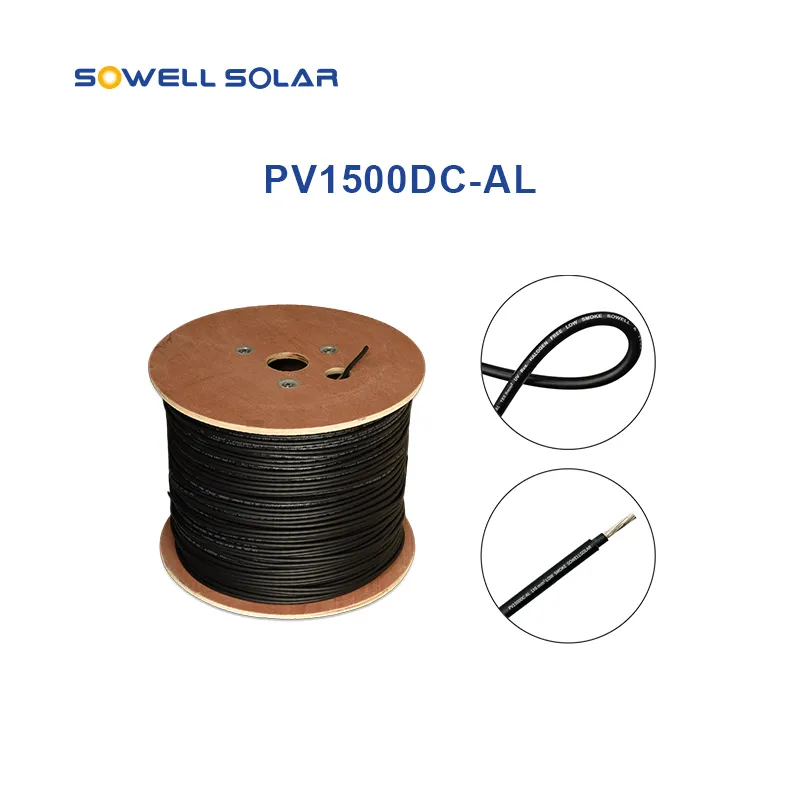
As solar installations scale up, 1500V DC architectures are drawing attention for their potential to reduce system complexity and improve the economics of large photovoltaic projects. Aluminum Solar Cabel PV1500DC-AL reflects an important industry discussion: how conductor materials, electrical design, and outdoor durability influence the performance of modern solar power systems.
The shift toward higher-voltage photovoltaic systems is not simply a matter of increasing voltage ratings. It also requires careful coordination between modules, inverters, cable insulation, connectors, and protection equipment. Understanding these relationships helps explain why cable selection has become an important part of solar project planning.
Utility-scale solar farms contain extensive networks of modules and electrical connections. In many installations, moving from 1000V to 1500V DC system architecture allows more modules to be connected in series, subject to equipment limits and local design requirements.
This configuration can reduce the number of individual strings and associated electrical components needed for a given installation capacity. It may also reduce the length of some cable routes and lower balance-of-system costs. However, the actual savings depend on site layout, equipment selection, inverter configuration, and engineering decisions.
Higher operating voltage also places greater demands on insulation coordination, connector compatibility, and electrical protection. Every component must be suitable for the system's maximum voltage and expected environmental conditions.
Copper has traditionally been widely used in electrical cables because of its high conductivity. Aluminum offers a different balance of properties, including lower density and potentially lower raw material costs. These characteristics have made aluminum conductors an area of interest in large-scale power transmission and selected photovoltaic applications.
The main advantage is weight. Aluminum is considerably lighter than copper for the same volume, which can make cable handling and transportation easier. In projects involving extensive cable networks, reducing conductor weight may also affect installation planning.
However, aluminum and copper are not interchangeable on a simple one-to-one basis. Aluminum has lower electrical conductivity by volume, so the conductor cross-section must be appropriately designed to meet current-carrying and voltage-drop requirements. Connection technology also matters because aluminum can develop an oxide layer, and unsuitable terminals may increase contact resistance.
For Aluminum Solar Cabel PV1500DC-AL, the relevant evaluation should therefore consider conductor dimensions, rated current, insulation performance, and compatibility with the selected connectors and terminals rather than focusing on material cost alone.
A suitable cable must meet the electrical and environmental requirements of the entire installation. The following factors deserve attention during project planning.
|
Selection Factor |
Why It Matters |
|---|---|
|
Rated DC voltage |
Must meet the system's maximum voltage and applicable standards |
|
Conductor cross-section |
Affects current capacity, voltage drop, and conductor temperature |
|
Insulation and sheath |
Protect against electrical stress and environmental exposure |
|
UV and weather resistance |
Important for cables installed outdoors over long periods |
|
Connector compatibility |
Helps maintain safe, low-resistance electrical connections |
|
Installation conditions |
Cable grouping, ambient temperature, and routing affect thermal performance |
Cable selection should be based on actual project calculations and verified product documentation. The 1500V designation alone does not establish that a cable is suitable for every solar installation.
Solar cables may experience years of sunlight, rain, humidity, temperature fluctuations, and mechanical movement. Poorly matched insulation or incorrect installation can accelerate degradation, potentially leading to insulation faults, power losses, or maintenance interruptions.
For this reason, project specifications should identify the applicable cable standard, rated voltage, operating temperature range, and required environmental resistance. Installation practices also matter: bend radius, support spacing, protection from sharp edges, and correct termination all contribute to service performance.
Aluminum conductors require particular care at connection points. Terminals must be approved for the conductor material, and installation should follow the specified preparation and tightening procedures. These details help reduce the risk of loose connections and localized overheating.
The development of 1500V photovoltaic systems reflects a wider effort to improve the cost and efficiency of solar power infrastructure. Aluminum conductors may offer practical advantages in suitable applications, but their performance depends on correct electrical sizing, compatible connections, and verified durability.
As photovoltaic projects continue to expand, Aluminum Solar Cabel PV1500DC-AL represents a useful starting point for examining how conductor materials fit into higher-voltage solar system design. Ultimately, sound engineering decisions—not voltage ratings or material choices in isolation—determine whether a cable installation delivers safe, efficient, and dependable service.